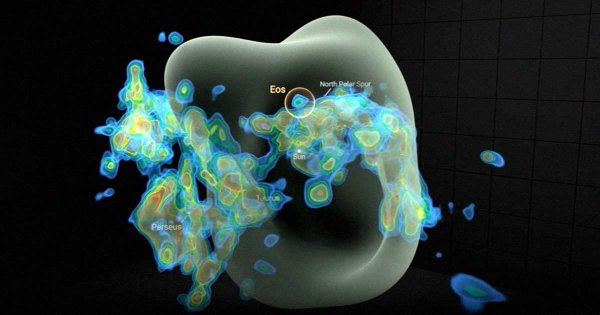
An international team of astronomers has discovered a crescent-shaped cloud of molecular hydrogen glowing in the far ultraviolet about 300 light-years from Earth, at the edge of the Local Bubble—the cavity that encompasses our solar system. The cloud, dubbed Eos, is detailed in a paper to be published in the journal Nature Astronomy.
The team, led by Blakesley Burkhart, an associate professor at the Rutgers School of Arts and Sciences, detected Eos by scanning the skies for ultraviolet emissions of molecular hydrogen using the far-ultraviolet spectrograph on South Korea's STSAT-1 satellite. This is the first time such a technique has been implemented; researchers conventionally rely on radio or infrared observatories to pick up chemical signatures.
A New Way to See Molecular Hydrogen
Eos had eluded detection because it does not emit the usual mix of carbon monoxide gases previously observed in radio and infrared surveys. "The data showed glowing hydrogen molecules detected via fluorescence in the far ultraviolet," Burkhart said in a statement. "This cloud is literally glowing in the dark."
Eos has a mass roughly 3,400 times that of the Sun and could take six million years to evaporate. The researchers hope the discovery will help them better understand the interstellar medium—the space between stars—and how molecular clouds of gas eventually form new stars.
"When we look through our telescopes, we catch whole solar systems in the act of forming, but we don't know in detail how that happens," Burkhart explained. "Our discovery of Eos is exciting because we can now directly measure how molecular clouds are forming and dissociating, and how a galaxy begins to transform interstellar gas and dust into stars and planets."
Burkhart framed the finding within a broader cosmic narrative: "The story of the cosmos is a story of the rearrangement of atoms over billions of years. The hydrogen in Eos has been traveling for 13.6 billion years since the Big Bang."
The team is also looking ahead to using NASA's James Webb Space Telescope to spot far more distant hydrogen clouds. In a draft paper, they report that "we may have found the very furthest hydrogen molecules from the Sun," Burkhart said. "So, we have found both some of the closest and farthest using far-ultraviolet emission."






Editorial Notes