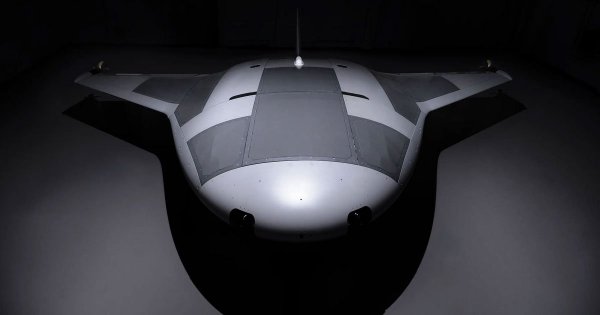
Defense contractor Northrop Grumman has released a photo of a sleek underwater drone called the Manta Ray, which closely resembles its oceanic namesake. The full-size uncrewed underwater vehicle prototype was developed under a 2020 contract by the Defense Advanced Research Projects Agency, or DARPA, and appears to be a low-profile underwater glider.
The craft can maneuver into enemy territory autonomously, according to the company, and even anchor itself to the sea bed to hibernate, allowing it to resume operations when needed. Both Northrop Grumman and DARPA have remained vague about the platform's exact purpose, leaving open interpretations that range from ocean temperature probes to missile launchers.
What the Manta Ray Is Designed to Do
Northrop Grumman says the extra-large glider is designed for long-duration, long-range and payload-capable undersea missions without need for on-site human logistics. DARPA describes the goal as giving the combatant commander an amplification of capacity without disrupting current operations by remaining independent of manned vessels and ports once deployed.
In a 2022 statement, Alan Lytle, Northrop's vice president of strategy and mission solutions, said the Manta Ray will provide payload capability from the sea, making it a critical component of subsea warfare and the Department of Defense's Joint All Domain Command and Control vision.
DARPA's website also lists underwater detection and classification of hazards or counter-detection threats as an objective, suggesting the platform could be equipped with systems such as radio jammers to disable adversary detection.
Weapon Payloads and Deployment Remain Unclear
According to the National Interest, some have speculated that the Manta Ray could be used for undersea mapping, mine detection, and passive surveillance, similar to the U.S. Navy's Orca extra-large UUV being developed by Boeing. Whether the craft will carry actual weapon payloads has not been disclosed.
It also remains unknown when, or if, the military will ever deploy a Manta Ray UUV. Even if it does, its exact purpose likely will not come to light soon, given the sensitivity of the matter.






Editorial Notes