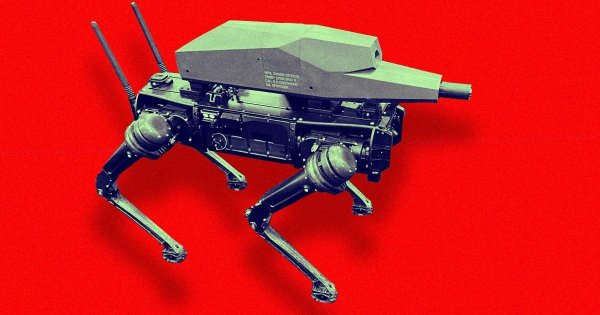
Ghost Robotics' recent debut of a robodog equipped with a sniper rifle has prompted sharp criticism from AI scholars and ethics experts, who describe it as a potential turning point in the development of lethal autonomous weapons. The robot, a Q-UGV model, carries a firearm made by SWORD International with a range of 3,900 feet, according to a breakdown by Kelsey Atherton in Popular Science.
UNSW Sydney AI professor Toby Walsh told Futurism that the armed robodog "crosses a moral, legal and technical line, taking us to a dark and dangerous world." He warned that such weapons will be used by terrorists and rogue states, calling them "weapons of terror." Walsh also noted that while the degree of autonomy in Ghost's robodog is unclear, militaries are already blurring the line between human-controlled drones and those with autonomous killing capability. He cited the November 2020 assassination of an Iranian scientist by Israeli operatives using an AI-assisted robot machine gun. "I only hope it adds urgency to the ongoing discussions at the UN to regulate this space, and quietens those voices saying the technology is a long way off," Walsh said. "It isn't."
University of California, Berkeley computer scientist Stuart Russell, who has written extensively on lethal autonomous weapon systems, said online reactions to the armed robodog have been overwhelmingly negative. "The vast majority of responses to this announcement on Twitter are of the 'hope you burn in hell' variety," Russell said. "That's because normal people understand that allowing machines to decide to kill humans is a bad idea. As one of the responses says, Terminator was a WARNING, not a MANUAL."
The decision to arm a robodog places Ghost Robotics ahead of competitor Boston Dynamics, which has publicly pledged not to weaponize its robots. Boston Dynamics was reportedly angry earlier this year when artists mounted a paintball gun to one of its Spot robodogs, a machine similar in size and function to Ghost's Q-UGV.
Not all experts share the alarm. University of Pennsylvania political science professor Michael Horowitz, another expert on autonomous weapon systems, told Futurism that he sees the robodog as similar to armed drones already used by many international militaries. "Given that the system is controlled by humans, and other countries have developed armed, remotely-piloted robotic ground systems, I am not sure this system raises any new ethical questions beyond those raised by any remotely-piloted system, whether in the air or on the ground," Horowitz said. "But I would need to know more about system details to be sure."






Editorial Notes